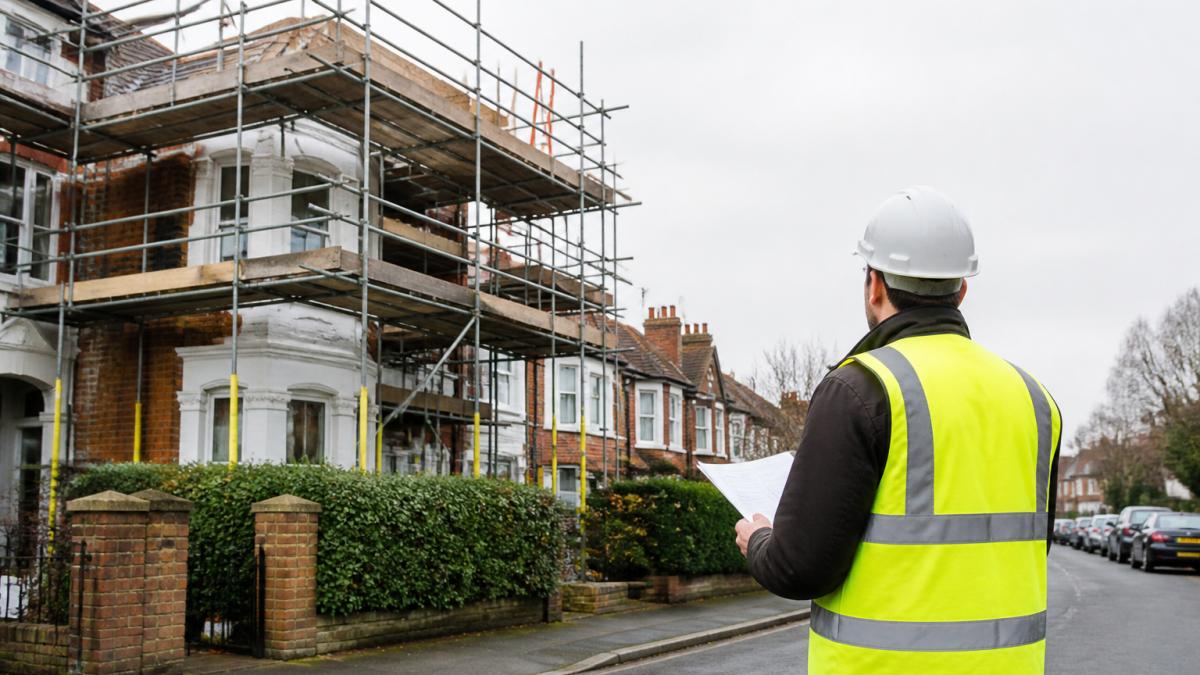
 how-to
Do You Need Council Permission for Scaffolding?
Table of Contents
- When You Need Council Permission for Scaffolding
- Scaffolding on a Public Highway or Pavement: Licence Requirements
- Scaffolding on Private Land and Neighbour Access Rights
- Erecting Scaffolding Without a Permit: Consequences and Liability
- The Scaffolding Licence Application Process
- How Long Can Scaffolding Stay Up and Licence Duration
- Your Next Steps: Getting Scaffolding Permission Sorted
- Frequently Asked Questions
Last Updated: October 7, 2026
When You Need Council Permission for Scaffolding
Whether you need council permission scaffolding depends on where it sits. If it extends onto a public highway, pavement, or footpath, you'll need a licence from your local council.
Erecting scaffolding without the right permissions can result in fines, removal orders, and liability issues that are expensive to fix.
Here's the key distinction: council permission for scaffolding is required when the structure occupies or projects above public space. Private land is simpler, but neighbour access rights and party wall considerations can still apply.
Scaffolding on a Public Highway or Pavement: Licence Requirements
Any scaffolding that occupies, projects over, or extends onto a public highway, pavement, or footpath requires a licence from your local council, including temporary structures that block pedestrian access, reduce pavement width, or create a hazard to traffic.
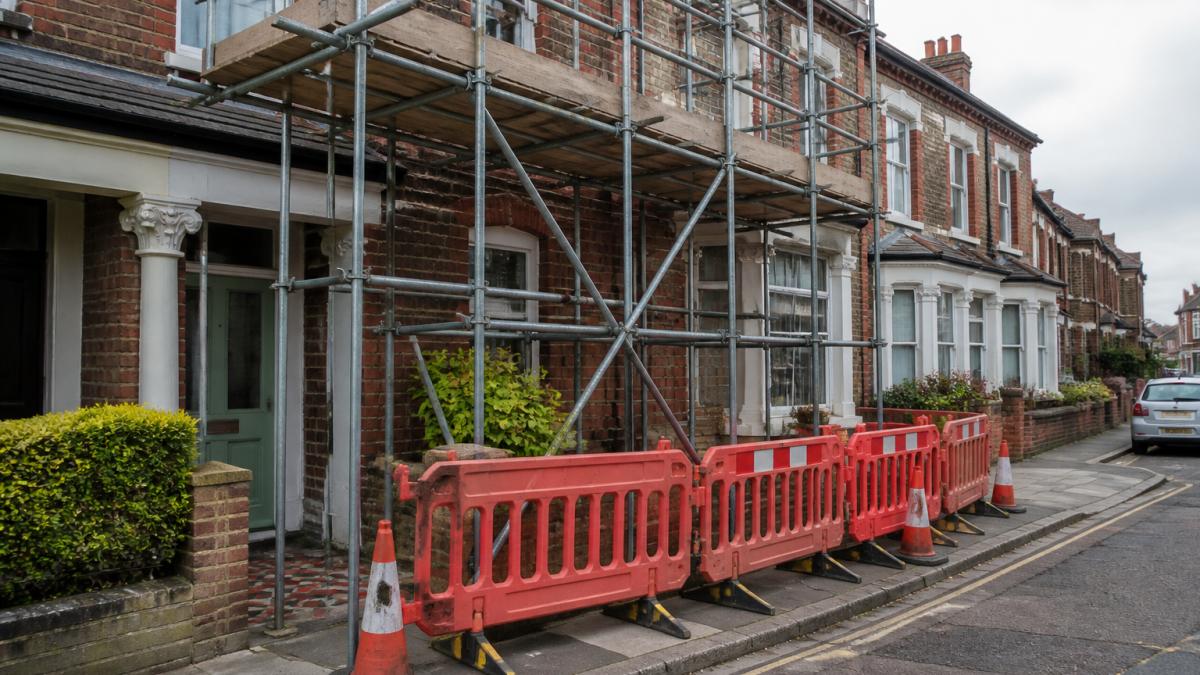
The council issues these licences to protect public safety.
What many homeowners don't realise is that the scaffolding licence for pavement is separate from building regulations or planning permission.
Your local council's highways department handles this, not planning. Contact them early: some councils require 7 to 14 days' notice, others longer, and delays can push back your project.
Key points on highway scaffolding:
- Applies to any structure on or above public land
- Required even for short-term repairs
- Local authority sets specific conditions
- Fines for breaching conditions can be substantial
Scaffolding on Private Land and Neighbour Access Rights
If your scaffolding sits entirely on your own property and doesn't cross onto neighbours' land, you won't need a council highway licence. But neighbour access rights and party wall rules can still apply.
If your scaffolding needs to extend over a neighbour's property, you'll need their written consent.
The Party Wall Act 1996 applies if you're doing structural work within 3 metres of a neighbour's property or within 6 metres at certain angles.
Common scenarios on private land:
- Your scaffolding stays within your boundary: no council licence needed
- Your scaffold touches a neighbour's wall: get written consent
- You're doing structural work near the boundary: serve Party Wall Act notice
- You're renting: check your lease for restrictions on external work
If you're unsure where your boundary line sits, get a surveyor's confirmation, a small investment that prevents costly disputes.
Erecting Scaffolding Without a Permit: Consequences and Liability
Erecting scaffolding without a permit where one is required carries real legal and financial consequences. Your local council can issue a notice requiring immediate removal, and you will pay for the removal plus any fines or charges.
The Work at Height Regulations 2005 require scaffolding to be erected safely, inspected at the required intervals and recorded as fit for use. An unlicensed structure on a public highway often has no inspection record, a liability on the property owner even if a contractor put it up.
What happens if scaffolding is erected without permission
- The council issues a notice requiring removal or compliance
- You pay for removal and any associated charges
- Fines apply, with the amount varying by council and duration
- Work halts until the paperwork is resolved
- Insurance may not cover related claims
- Enforcement action under health and safety law is possible
If you spot scaffolding on a public highway without a licence
If scaffolding has been erected on a pavement, road or other public space near you and you believe no licence is in place, you can act without confronting anyone on site.
- Note the location and dates. Record the address, the exact stretch of pavement or road affected, and when the scaffold first appeared.
- Check the licence. Many councils publish a register of highway licences or street-works permits. If you cannot find one, ask the council's highways or street-works team directly.
- Report it to the council. Use the online reporting form for highway obstructions, or phone the highways department. Provide photographs showing the scaffold, the pavement width remaining, and any missing barriers, signage or lighting.
- Report urgent safety hazards separately. If the scaffold is unstable, unlit at night, blocking a crossing, or forcing pedestrians into the road, say so and ask for an urgent inspection.
- Keep a record. Save your report reference number, the date, and any response, and follow up if the obstruction continues.
If scaffolding has been put up on your land without your consent
Unauthorised access to private land is a civil matter, not a council licensing issue, but it still needs resolving quickly.
- Do not touch the structure. Moving or dismantling it can make you liable for damage or injury.
- Identify who erected it. Ask the neighbouring property owner or the contractor named on any signage.
- Put your objection in writing. Send a dated letter or email to the neighbour and contractor stating the scaffold is on your land without permission and requesting removal by a specified date.
- Set a reasonable deadline. Give a short but fair period, such as 7 to 14 days.
- Escalate if ignored. Seek legal advice about trespass and, where damage has occurred, recovering repair costs. Your home insurance legal-expenses cover may help.
- Consider a licence agreement. If you allow the scaffold to stay, a short written licence setting out duration, insurance and reinstatement obligations protects both sides.
Preventing the problem in the first place
Before any scaffold goes up, confirm in writing who is applying for the highway licence, who holds the public liability insurance, and who is responsible for inspections and removal. If the scaffold will cross a boundary, get the neighbour's written consent and, where structural work is involved, check whether the Party Wall etc. Act 1996 requires notice.
The Scaffolding Licence Application Process
Applying for a council permission scaffolding licence is usually straightforward, but the quality of your application decides how quickly it is approved. Most highway authorities accept applications online, and a well-prepared submission is typically decided within 5 to 10 working days. Incomplete applications are the biggest cause of delay, so treat the checklist below as the minimum.
What a typical application requires
- Applicant name, address, phone number and email
- The property address and full postcode where the scaffold will stand
- Exact start and end dates, including the date the scaffold comes down
- A site plan or sketch drawn to scale showing the scaffold footprint, the pavement width remaining for pedestrians, and any traffic-management measures
- A description of the works the scaffold supports (roof repair, render, extension, gutter replacement and so on)
- Scaffold contractor name, address and public liability insurance details
- Confirmation that the structure will be erected, altered and dismantled by a competent person and inspected as required
- A named responsible person the council can contact on site
Some authorities also ask for photographs, a method statement, a copy of the contractor's public liability certificate (commonly £5 million or £10 million cover), and evidence of employer's liability insurance. A few still require a paper form, so check the specific council's highways or street-works page first.
Documents to have ready before you apply
- Public liability insurance certificate for the scaffold contractor
- Employer's liability insurance certificate if the contractor employs staff
- A scaled site plan or clear sketch with measurements
- Project programme showing erection, use and dismantling dates
- Contact details for the site supervisor
- Any traffic-management or pedestrian-diversion plan if the pavement will be narrowed or closed
Realistic timelines
- Initial council enquiry: same day to 2 working days for a reply
- Application preparation: 1 to 3 days if documents are already in hand
- Council decision: 5 to 10 working days for a standard residential application
- Complex or busy-highway applications: 10 to 20 working days, sometimes longer if a traffic order is needed
- Licence extension request: 3 to 5 working days
Add at least a week of buffer: councils process applications in order, and a bank holiday or backlog can push a decision past the quoted window.
Fees, deposits and renewals
Licence fees vary widely by authority and by how much public space the scaffold occupies. A common range for a residential pavement licence is around £50 to £150, but some councils charge more for longer durations or structures that take up a traffic lane.
If your project overruns, apply to extend the licence before the original expiry date. Most councils allow one or two extensions without a fresh application, but the extension is not automatic and the fee may be charged again. Leaving scaffolding up after expiry is a breach, and enforcement follows quickly.
Who actually submits the application
The person or business erecting the scaffold on the highway is normally the licence holder, because the licence attaches to the structure and the occupation of public space. In practice, the scaffold contractor applies, pays the fee and holds the insurance.
Find your local council's highways or street-works licensing page
Ironclad Scaffolding handles this paperwork for our customers. We include licence handling in our packages, which saves you time and the risk of rejection delays.
How Long Can Scaffolding Stay Up and Licence Duration
The duration of your licence depends on how long you need the scaffolding.
How long can scaffolding stay up legally? There's no absolute limit, it's how long your licence permits.
Leaving scaffolding up after your licence expires is a breach: the council can issue a notice and force removal at your cost.
Typical licence durations for residential work:
- Roof repairs: 4 to 8 weeks
- Extensions: 8 to 16 weeks
- Facade work or painting: 2 to 6 weeks
- Major renovations: 12 to 20 weeks
When calculating your timeline, add a buffer. Projects often run 2 to 4 weeks longer than planned.
Ironclad Scaffolding includes ten weeks of hire in every package. If you need longer, we extend the hire and manage the licence extension with the council.
Your Next Steps: Getting Scaffolding Permission Sorted
Start by checking whether your scaffolding needs council permission.
Next, contact your local council's highways department with your address and project outline.
If your scaffolding is on private land only, check for neighbour boundary issues and Party Wall Act requirements.
Then gather your application materials: property address, project dates, site sketch, and contractor details. Submit online if your council offers it.
Finally, arrange your scaffolding hire well before you need it. Contractors typically need 5 to 10 working days' notice.
The key is starting early. Council permissions take time. Contractor availability matters.
Getting the right permissions protects your project and keeps you compliant with local regulations. When you're planning roof repairs, extensions, or exterior work in Kent, we handle the administrative complexity so you can focus on the work itself. Contact your local council's highways department to confirm your specific requirements, then get in touch with us for a transparent quote and hassle-free licence management.
Frequently Asked Questions
Do I need a council licence if scaffolding is on the pavement?
Yes, if your scaffolding extends onto or above the public pavement or highway, you need a licence from your local council. This applies even if the scaffolding is temporary. The council requires advance notice and formal permission to ensure public safety and maintain access. Contact your local authority early in your project planning to start the application process.
What happens if you put scaffolding up without a permit?
Erecting scaffolding without the required council permission is illegal and can result in enforcement action. Your local authority can issue a notice requiring removal, and you may face fines. You could also be liable for any damage or injuries. If you discover scaffolding has been erected without permission, report it to your council immediately. Always obtain proper licences before work begins.
Can a neighbour refuse access for scaffolding on their property?
Yes, neighbours can refuse access to their land for scaffolding. You cannot legally place scaffolding on a neighbour's property without their written consent. If access is needed, you must negotiate and obtain formal permission. If agreement cannot be reached, you may need to explore alternative methods or seek legal advice about rights of way or Party Wall Act procedures if applicable.
How long can scaffolding stay up before the licence needs renewing?
Scaffolding licence duration varies by local council, typically ranging from a few weeks to several months. Most councils issue licences for specific project periods. Check your licence terms for the expiry date and any renewal requirements. If your project extends beyond the licence period, apply for renewal well in advance. Ironclad Scaffolding includes ten weeks of hire in every package and handles the licensing process for you.