 How-to
How Long Does Scaffolding Hire Last in 2026?
Last Updated: November 12, 2026
Quick Summary
Scaffolding hire usually lasts a few days for small repairs and two to four weeks for a typical roof job, while rendering or painting takes three to six weeks. Ironclad Scaffolding includes ten weeks of hire in its standard package, and the agreed period is set out in writing in your quote.
- Erection and dismantling each take less than a day for most homes.
- Planning ranges: small repairs take days to two weeks; full re-roofing takes six to ten weeks or more.
- Confirm in writing whether the hire period is fixed or a minimum term.
- Agree any extension in writing before the agreed end date, not on the last day.
- Ask how part-weeks are billed, since a short overrun can cost the same as a full week.
Table of Contents
- What Determines Your Scaffolding Hire Period
- How Long Can Scaffolding Be Left Up Safely?
- Scaffolding Hire Costs and Weekly Charges
- Extending Your Scaffolding Hire Without Surprises
- What Happens When Your Project Overruns
- Arranging Scaffolding Removal After Work Finishes
- Booking Your Scaffolding Quote and Hire Period
- Frequently Asked Questions
What Determines Your Scaffolding Hire Period
Most homeowners in Kent ask the same question before any work starts: how long will the scaffolding stay up? The honest answer is that the hire period depends on the job, the weather and how quickly the trades move.
Scaffolding hire is the agreed length of time the structure stays on your property. It is not the same as the time it takes to put up or take down.
Four factors shape how long you need it:
- The size of the property and how many elevations need access
- The type of work being done, such as roof repairs, rendering or painting
- Weather and site conditions, which often cause delays
- How well the trades are scheduled and how quickly each stage is signed off
Standard hire periods included in a quote
Every quote from us states the hire period clearly before you agree to anything. Our packages include ten weeks of hire.
Check these points on any quote, including ours:
- The start date and the agreed end date
- Whether the hire period is a fixed term or a minimum term
- What happens if the work runs past the agreed date
Published guidance varies on typical minimum periods. Some providers quote short minimums of a few days, while MyJobQuote Complete Scaffolding Cost Guide (UK Prices 2026) reports that most firms require six to eight weeks. Always read the hire agreement rather than relying on a general figure.
Hire periods by project type
Different jobs need very different timelines. Use this rough guide when planning your project:
- Small repairs or single-elevation work: often a few days to two weeks
- Roof repairs on a typical semi-detached house: usually two to four weeks
- Rendering or exterior painting: commonly three to six weeks, depending on drying times
- Home extensions or full re-roofing: often six to ten weeks or more
These are planning ranges, not promises. Your exact period depends on the scope we agree on your quote.
How Long Can Scaffolding Be Left Up Safely?
This is a different question from how long you have hired it. Hire length is a contract matter. Safe time erected depends on inspection and condition.
Scaffolding can stay in place for as long as the work needs it, provided it remains safe and is regularly inspected.
Our practical checks include:
- Inspection of boards, guardrails and ties at regular intervals
- Removal of any damaged or unsafe components straight away
- Written confirmation before any extension is agreed
Scaffolding left up with no work happening is a problem. Weather damage, loose fittings and unauthorised access all become risks over time. If you ever see scaffolding that looks damaged or abandoned on your property, contact us so we can inspect it.
Scaffolding Hire Costs and Weekly Charges
Pricing depends on the size of your property, the scope of work and the hire period. Prices are set out in your written quote. Visit our website for current prices or request a quote.
Our standard package includes ten weeks of hire. If your project runs beyond that, the hire agreement sets out how extra time is charged. Ask for the weekly or extension rate in writing before work begins so there are no surprises.
Keep these points in mind when comparing quotes:
- Confirm whether highway licensing is included
- Check whether the price covers erection, hire and dismantling
- Ask how any overrun is calculated and billed
Pricing depends on property size, scope and hire period, so the table below sets out the key figures and terms the article states.
| Item | Value | Note |
|---|---|---|
| Included hire period | Ten weeks | Standard package from Ironclad Scaffolding |
| Extension charge | Weekly or extension rate | Agreed in writing before work begins |
| Highway licensing | Confirm if included | Check whether it is part of the price |
| Quote turnaround | Within 24 hours | Written quote after instant quote tool |
Extending Your Scaffolding Hire Without Surprises
Projects change. A storm delays the roof, or the render takes longer to cure. Extending the hire is normal, but it should be agreed early, not on the last day.
A simple extension process works well:
- Tell us as soon as you expect the work to run late
- Agree the new end date in writing
- Confirm any extra charges before the extension starts
- Check whether an updated highway licence is needed
Extensions can also affect permits. Our team handles the highway licence and will tell you if your extension needs a new application.
What Happens When Your Project Overruns
Overruns are the single most common source of unexpected scaffolding bills, and they almost always come from four places: weather that stops work, trades not being ready when the scaffold is, materials arriving late, or defects discovered once the structure is up. Each is manageable if you act before the agreed end date, not after it.
Check these contract terms before you sign
The hire agreement, not a verbal promise, decides what an overrun costs. Before work starts, confirm in writing:
- The included hire period, the number of weeks covered by the quoted price, and whether it is a fixed term or a minimum term
- The extension rate, the weekly or daily charge for time beyond the included period, and whether it is charged per week, per day, or in part-weeks
- Notice requirements, how many days' notice the scaffolder needs before the end date to extend without penalty
- Responsibility for delays, whether weather, trade availability, or defects found during the work are treated as chargeable extensions or as covered by the original period
- Highway licence terms, whether the licence duration matches the hire period and who pays for a licence extension
A common pattern is for the included period to be generous enough for the planned work but for the extension rate to be charged in full weeks, so a two-day overrun can cost the same as seven. Ask how part-weeks are billed.
A worked example of how overruns affect the bill
Rates vary by provider, property size and region. The structure matters as much as the headline figure: confirm whether extensions are billed weekly, daily, or in blocks, because the difference compounds over a long overrun.
Who is responsible for the delay
Responsibility usually follows the cause. Weather delays are typically treated as chargeable extensions because the scaffolder cannot control them, while delays caused by the scaffolder's own scheduling are normally their cost to absorb. Delays caused by other trades, a roofer who does not turn up, a renderer waiting on materials, usually fall to the customer under the hire agreement, even though the customer did not cause them directly. Read the delay clause and, if the wording is unclear, ask the scaffolder to confirm in writing how each scenario is treated.
Reduce avoidable hire time
Most overruns are avoidable with coordination. Confirm the trades' start dates before the scaffold goes up, book deliveries so materials arrive before the scaffold is needed, and build a weather buffer into the programme for external work. Agree inspection dates in advance so a missed inspection does not stall the job.
Watch out: if the agreement treats all delays as chargeable regardless of cause, a single bad-weather week can cost more than expected, get the delay clause clarified before signing.
Arranging Scaffolding Removal After Work Finishes
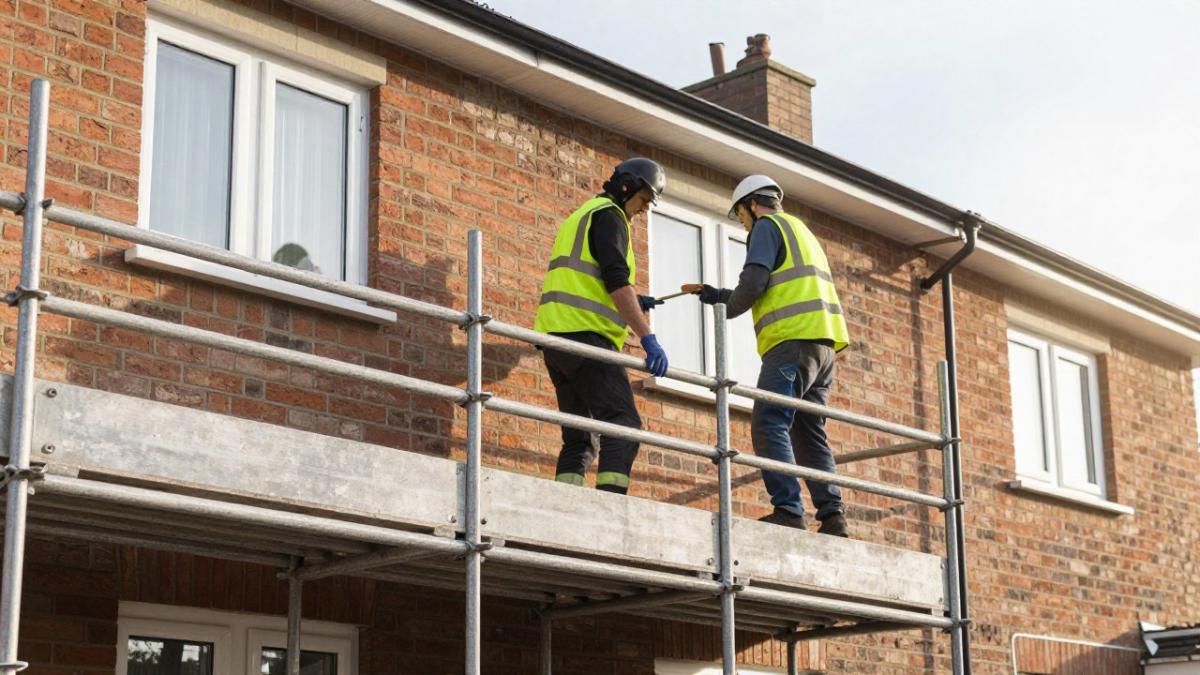
Removal is where hire periods quietly stretch. Dismantling itself takes less than a day for most homes, but the booking, notice and licence closure around it are what determine whether the scaffold comes down on time or sits on your property accruing hire charges.
Who requests dismantling, and when
The customer or the main contractor normally requests dismantling once the final trade has signed off the work. In practice the trigger is the completion of the last external task, the final coat of render, the last roof tile, the sign-off inspection, not the date on the original programme. Book the dismantling date as soon as that trigger is in sight rather than waiting for the work to finish, because scaffolders schedule dismantling alongside erections and a short-notice request can slip by days.
How much notice to give
Notice periods vary by provider and by how busy the diary is. A common pattern is for scaffolders to ask for several working days' notice to book a dismantling slot, and longer during peak periods when erections are also in demand. Confirm the notice requirement in your hire agreement at the outset and diarise the request date so it does not get missed. If the work finishes early, tell the scaffolder straight away, bringing dismantling forward reduces hire time and is usually easier to accommodate than pushing it back.
A practical dismantling timeline
- Final trade signs off, confirm all external work is complete and inspected
- Request dismantling, give the notice period stated in your agreement
- Clear the area, move vehicles, bins and materials so the dismantling crew has access
- Dismantling day, typically less than a day for a domestic property
- Close the highway licence, confirm with the scaffolder that any licence is closed, because an open licence can continue to attract charges even after the scaffold is gone
- Final check, confirm the scaffold, boards and fittings are removed and the ground is left clear
If the scaffolding is still up after the work is finished
Sometimes the work ends and the scaffold stays. The first step is a written request to the scaffolder asking for a dismantling date and confirming the hire period has ended. If there is no response, follow up in writing and keep a record of the dates.
Watch out: an open highway licence can keep generating charges after the scaffold is gone, so confirm closure in writing rather than assuming dismantling ends the cost.
Booking Your Scaffolding Quote and Hire Period
Getting the right hire period starts with a clear quote. Here is how to get one from Ironclad Scaffolding:
- Use our instant quote tool to describe your property and project
- Use the 3D scaffold viewer to check how the scaffolding will sit on your home
- Receive a written quote within 24 hours
- Confirm the hire period, start date and end date before booking
Our 3D scaffold viewer lets you see the layout on your own property before anything goes up.
We handle highway licensing as part of the service, so you do not need to deal with the council yourself. Ironclad Scaffolding offers transparent domestic scaffolding across Kent, with ten weeks of hire included in every package.
Ready to plan your project? Request your instant quote from Ironclad Scaffolding today and get your hire period confirmed in writing.
Frequently Asked Questions
How long does scaffolding hire usually last?
There is no single answer. Minimum hire terms vary between providers. Ironclad Scaffolding includes ten weeks of hire in every package. Check the period written into your quote and hire agreement, as that is what governs how long you pay for.
Is scaffolding hire charged by the week or by the month?
Hire is usually agreed as a set period, with extra time charged on a weekly basis once that period ends. The exact structure depends on the scaffolder, so confirm the extension rate in writing before work starts. Ironclad Scaffolding provides written quotes within 24 hours.
Can scaffolding be left up after the work is completed?
Scaffolding can be left in place only while it remains safe and is needed. The scaffold should be inspected regularly, and an extension arranged if it stays up longer. Leaving scaffolding erected after work finishes means paying for hire you no longer need, so arrange dismantling as soon as the job is done.
Can I extend my scaffolding hire?
Yes. Contact your scaffolder before the agreed hire period ends rather than after, because late extensions can cost more and may leave the scaffold standing without an agreed period. Ask for the extension rate, whether a percentage charge applies, and whether the scaffold needs an inspection before the extension takes effect. Get the new end date confirmed in writing.