 How-to
Scaffolding Hire Duration for Renovations: 2026 Guide
Table of Contents
- How Long Does Scaffolding Stay Up for a Renovation?
- Typical hire durations by project type
- Minimum hire periods and why they exist
- Scaffolding Permit Requirements: What You Need Before Erection
- How to Plan Scaffolding for Roof Repairs
- Scaffolding Hire Extension Fees and Overrun Costs
- What Delays a Scaffolding Hire Period?
- Short-Term vs Long-Term Scaffolding Hire
- Frequently Asked Questions
Last Updated: September 21, 2026
How Long Does Scaffolding Stay Up for a Renovation?
Scaffolding hire duration for renovations usually runs between two and twelve weeks, depending on the job. A simple roof repair might need the scaffold for two to three weeks. A full house renovation can keep it up for three months or more.
Typical hire durations by project type
Hire length tracks the work itself. A domestic renovation and a commercial scaffolding job rarely need the same window.
- Roof repairs: 2-4 weeks for tiles, flashing or a leak fix
- Chimney work: 3-5 weeks including repointing
- Exterior painting: 3-4 weeks for a full house
- Home extension: 8-16 weeks for shell and roof
- Full house renovation: 12-20 weeks or more
- Loft conversion: 10-14 weeks
Minimum hire periods and why they exist
Most providers set a minimum hire duration. That floor covers erection, safety compliance checks and dismantling, not just the days the scaffold stands.
Scaffolding Permit Requirements: What You Need Before Erection
Scaffolding permit requirements depend on where the structure sits. If any part of the scaffold overhangs a public road, pavement or footpath, you need a highway licence (also called a scaffold licence or pavement licence) from the local council (Scaffolding and hoarding licence (England and Wales)). If the scaffold stays fully inside your property boundary, you usually need no permit at all, but that is not always possible on tight urban sites.
Highway licences and council approval times
Council approval times for a highway licence often run from a few days to several weeks. The wait depends on the council's workload and how complete your application is. You will typically need to supply:
- A site plan showing the scaffold footprint
- Dates for erection and dismantling
- Proof of public liability insurance
- Traffic or pedestrian management details, if needed
- A method statement and risk assessment for the works
The duration limit nobody mentions
A highway licence is time-limited. Councils typically grant them for a set window, often one, three or six months, and the scaffold must come down by the expiry date unless you apply to extend. This is the hidden constraint on hire duration: your project may be running fine, but if the licence lapses, the scaffold has to be removed regardless.
Key implications for your hire period:
- Apply for a licence window that covers your realistic finish date, not your optimistic one. Extending a licence mid-project usually means a fresh application, a fresh fee and a fresh wait.
- Licence fees vary by council and by the length of the occupation. They are usually charged per week or per month, so a longer licence window costs more upfront but avoids the risk of an unlicensed scaffold.
- Conditions can restrict working hours. Some licences limit when crews can erect, dismantle or work from the scaffold, which can stretch the calendar time your scaffold needs to stay up.
- A lapsed licence is not a paperwork problem, it is an enforcement problem. Councils can require immediate removal, and the cost of an emergency dismantle and re-erect usually dwarfs the extension fee.
How to align licence duration with hire duration
Treat the licence expiry date as a hard deadline in your project plan, not a soft one. Build the following into your schedule:
- Confirm the licence window before you sign the hire contract.
- Match the hire period to the licence period, with a small buffer for dismantling.
- Diarise the expiry date and apply to extend at least two weeks before it lapses if the job is slipping.
- Tell your scaffold provider as soon as the finish date moves, they can often re-sequence crews if they know early.
How to Plan Scaffolding for Roof Repairs
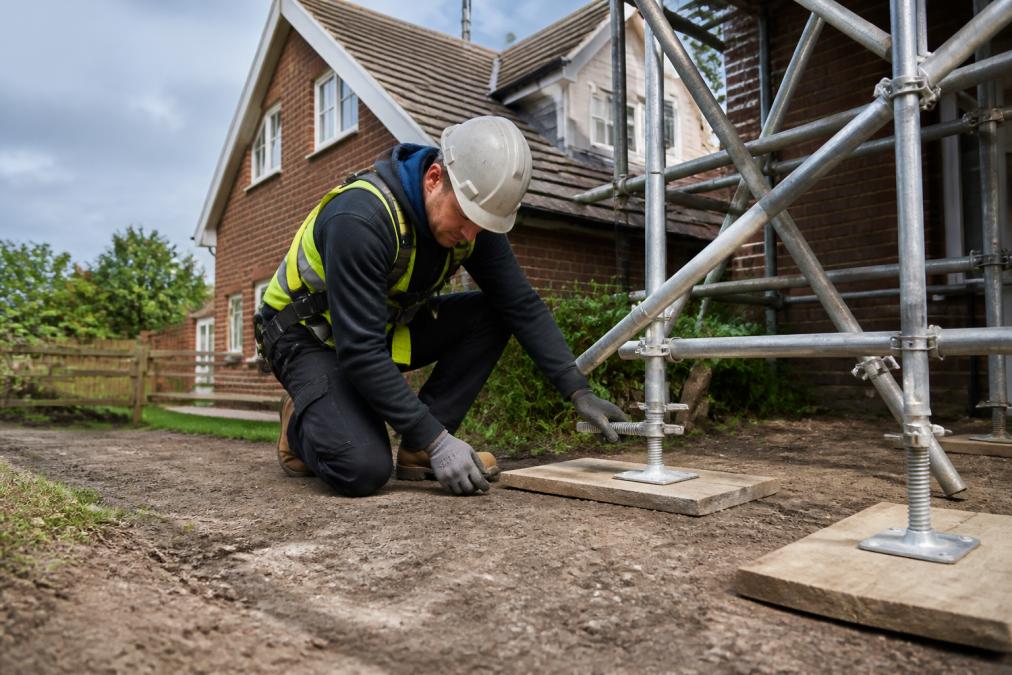
Planning scaffolding for roof repairs starts with the ground, not the roof. Soft or uneven ground needs spreader plates to keep the structure stable.
A scaffolder will check several things before erection:
- Ground conditions and slope
- Site access for delivery and crew
- Distance from the building
- Height and reach needed
- Proximity to drains, cables or boundaries
Ground conditions, base plates and sole boards
Base plates spread the weight of each leg onto the ground. Sole boards go under the base plates to spread that load further on soft surfaces.
Scaffolding Hire Extension Fees and Overrun Costs
Scaffolding hire extension fees apply when your project runs past the agreed hire period. Most contracts charge a weekly rate for each extra week.
Weekly extension rates explained
Weekly extension rates are the price you pay for each week beyond your fixed-term agreement. They are usually higher than the rate baked into your original hire.
To avoid overrun costs:
- Build a buffer into your hire period
- Tell your provider early if the job is slipping
- Ask about a longer fixed term before you start
What Delays a Scaffolding Hire Period?
Delays come from two main sources: weather and logistics. Both are predictable, and both can be planned for, but only if you negotiate the right terms before you sign the hire contract.
Weather-related delays and how to negotiate them
Work at height stops when winds get too strong. As a rule of thumb, most scaffolders will not work above roughly 15-20 mph sustained wind, and many will not sheet or work on exposed elevations in anything stronger. Rain makes roofs and boards slippery. Frost can halt work for days at a time.
- Weather days clause. Some providers will agree to pause the hire clock on days when work is impossible for safety reasons, provided the site is logged and the provider is notified the same day. This is not standard, but it is negotiable on longer hires.
- Force majeure wording. Check whether the contract's force majeure clause covers severe weather. Many standard terms do not, which means weather delays are your risk, not the provider's.
- A weather buffer built into the fixed term. If the provider will not pause the clock, ask for the fixed term to be quoted with an extra two weeks at the standard rate rather than the extension rate. This is often cheaper than paying weekly extensions later.
- Seasonal pricing. Hires booked over winter carry more weather risk. Some providers price this in; ask whether a winter hire can be quoted with a longer fixed term at a reduced weekly rate.
Dismantling lead times
Dismantling usually needs to be booked in advance. Crews are scheduled, and a busy provider may not reach you for several days, sometimes longer in peak season. That gap matters because your hire period may still be running while you wait for the crew.
Practical steps:
- Book dismantling as soon as you know the finish date. Do not wait until the last day of work.
- Confirm in writing when the hire clock stops. Ask the provider to state whether it is the request date or the dismantling date. Get it in the contract.
- Allow a realistic gap. A common pattern is a three to seven day wait between requesting dismantling and the crew arriving. Build that into your schedule.
- Check whether the scaffold is charged during the wait. Some contracts charge hire up to the dismantling date; others stop at the request date. The difference can be a week or more of fees.
Short-Term vs Long-Term Scaffolding Hire
Short-term hire suits quick jobs: a leak fix, a gutter repair, a single elevation of painting. It keeps costs down and gets the scaffold off site fast.
| Project type | Typical duration | Best hire type |
|---|---|---|
| Roof repair | 2-4 weeks | Short-term |
| Exterior painting | 3-4 weeks | Short-term |
| Home extension | 8-16 weeks | Long-term |
| Full renovation | 12-20 weeks | Long-term |
Frequently Asked Questions
How long is the average scaffolding hire period for home renovations?
For a domestic renovation such as a roof repair or exterior painting, scaffolding typically stays up for four to eight weeks. Full house renovations with rendering or roof replacement often need eight to twelve weeks. Ironclad Scaffolding includes ten weeks of hire in every package, which covers most domestic projects without extra charges. If your project runs longer, weekly extension rates apply from the end of the initial period.
Do I need a permit for scaffolding on a public highway?
Yes. If any part of the scaffold sits on a public road, pavement or verge, you need a highway licence from the local council. This is separate from any planning permission and can take one to three weeks to process. The scaffolder usually applies on your behalf. Ironclad Scaffolding handles the highway licence as part of its service, so you do not deal with the council directly.
Can I extend my scaffolding hire period once it is installed?
Most hire contracts allow extensions, but you need to arrange them before the initial period ends. Extension fees are charged at a weekly rate set out in your original agreement. Ironclad Scaffolding includes ten weeks of hire in every package, and if your roof repair or renovation overruns, you pay the agreed weekly extension rate. Confirm the rate in writing before the scaffold goes up so there are no surprises.
What factors influence how long scaffolding stays up?
The main factors are project type, weather, ground conditions and dismantling lead times. Roof repairs usually need four to six weeks, while full house renovations can need eight to twelve. Heavy rain or high winds can pause work and push the timeline out. Soft ground may require sole boards and base plates, which adds setup time. Dismantling itself often needs booking one to two weeks in advance, so factor that into your schedule.
A renovation rarely runs exactly to plan, and scaffold hire is where that slippage shows up on the bill. Ironclad Scaffolding removes the guesswork with instant quotes, a 3D scaffold viewer so you can see the structure on your home before it goes up, and ten weeks of hire included in every package. We also handle the highway licence for you, so council paperwork never stalls your start date. Get started with Ironclad Scaffolding and lock in a written quote within 24 hours.