 ultimate-guide
Cost of Domestic Scaffolding Hire: 2026 Price Guide
Table of Contents
- How Scaffolding Hire Is Charged: Project vs Weekly Rates
- Scaffolding Hire Cost Per Week: What Drives the Rate
- Scaffolding Hire Duration for Renovations: How Long Do You Need It?
- Scaffolding Cost for a Semi-Detached House vs Other Property Types
- What a Transparent Scaffolding Quote Should Itemise
- Scaffolding Quote Checklist: What to Compare Before You Commit
- Permits, Pavement Licences and Public Liability Explained
- Fixed Scaffold vs Scaffold Tower: Which Is Right for Your Job?
- Frequently Asked Questions
Last Updated: October 15, 2026
How Scaffolding Hire Is Charged: Project vs Weekly Rates
Domestic scaffolding hire is usually charged one of two ways: a fixed project price, or a weekly rate from the day the scaffold goes up.
Scaffolding hire is the rental of a temporary working platform, erected by a qualified scaffolder, for exterior access during repair, maintenance or construction.
Two quotes for the same house can differ by hundreds of pounds without either being wrong: one may include a generous hire window, the other may charge weekly from day one.
Initial Hire Periods and What Happens After
An initial hire period is the number of weeks included in the quoted price before extension charges begin. Ten weeks is a common allowance for domestic work, and it is the period we build into every package. Finish early and you pay nothing extra; overrun and you move onto the weekly extension rate.
Scaffolding Hire Cost Per Week: What Drives the Rate
Weekly scaffolding hire cost depends on the size of the structure, its height and length, access difficulty and site conditions. A single lift along a bungalow is very different from a three-storey elevation with limited parking and overhead cables.
The main drivers are:
- Scaffold height and length - taller and longer elevations need more tube, boards and labour
- Access difficulty - narrow driveways, sloping ground and restricted delivery windows add time
- Site conditions - soft ground may need spreader plates or a different base
Light-duty scaffold for painting and decorating carries a lower rate than a heavier fixed scaffold built for roofing and materials loading. A scaffold tower is cheaper again, but only suits shorter, simpler jobs.
Scaffolding Hire Duration for Renovations: How Long Do You Need It?
Scaffolding hire duration for renovations typically runs from two weeks for a straightforward roof repair to ten weeks or more for a full extension or re-render.
If the roofer, renderer and painter are booked in sequence, the scaffold stays for all three.
Group exterior trades into one window: book the scaffold once, get everyone on site in the same fortnight or month, and let it come down when the last trade finishes.
Scaffolding Cost for a Semi-Detached House vs Other Property Types
Scaffolding cost for a semi-detached house sits in the middle of the domestic range: more elevation than a terrace, less than a detached property with multiple exposed sides.
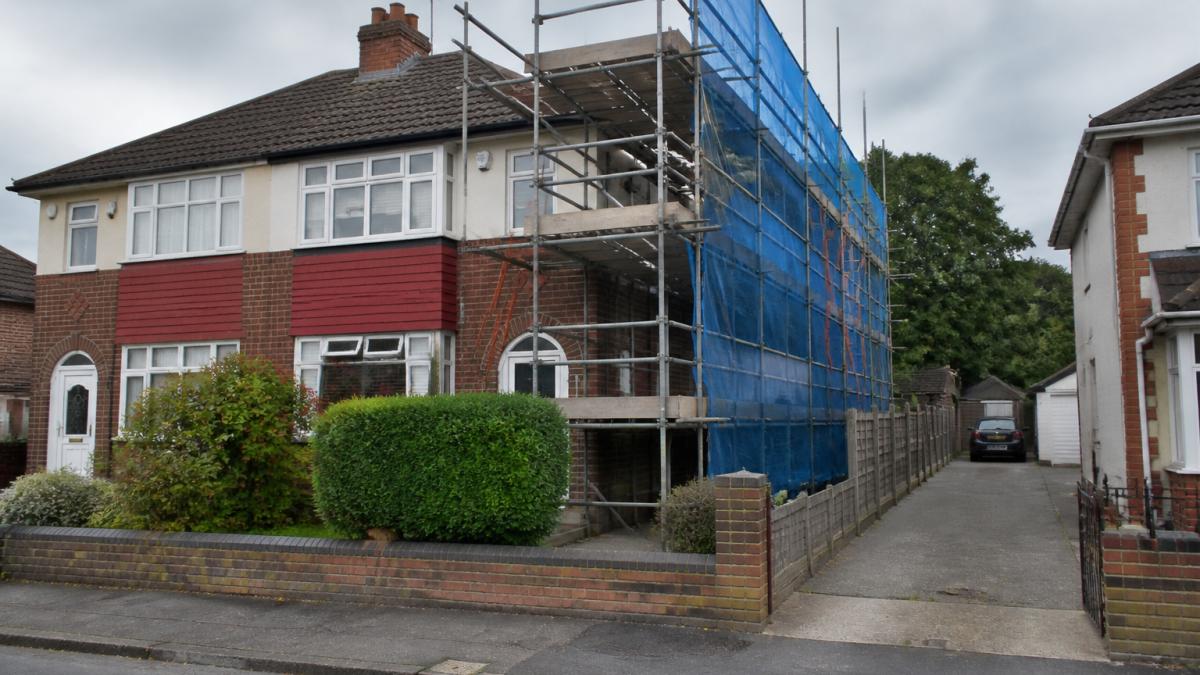
A single-storey extension on a bungalow needs far less structure than a full re-roof on a three-bedroom semi.
| Property type | Typical scope | What pushes the price up |
|---|---|---|
| Single-storey / bungalow | One low elevation | Minimal height, short hire |
| Semi-detached house | One or two elevations | Party wall access, parking |
| Detached house | Two or three elevations | Total scaffold area |
| Terraced house | Front or rear only | Narrow access, shared boundaries |
What a Transparent Scaffolding Quote Should Itemise
A transparent scaffolding quote itemises delivery, erection, the initial hire period, dismantling and collection as separate lines. A single lump sum tells you nothing about what happens if the job overruns.
A proper written quote should show:
- Delivery and collection charges
- Erection labour and the date it will go up
- The initial hire period included in the price
If a provider will not break the quote down, treat that as a warning sign: you cannot compare two quotes fairly if one hides its extension rate.
A Worked Example: How the Lines Add Up
Seeing how the lines combine into a total is the only way to compare two quotes like for like.
| Line | What it covers | Illustrative amount |
|---|---|---|
| Delivery | Transport of tube, boards and fittings to site | £150 |
| Erection | Labour to build the structure, one visit | £900 |
| Initial hire (10 weeks) | Rental of the structure for the included period | £600 |
| Dismantling | Labour to strike the structure, one visit | £700 |
| Collection | Transport away from site | £150 |
| Subtotal | £2,500 | |
| VAT at 20% | £500 | |
| Total | £3,000 |
Now add the overrun. Three weeks past the included period at £60 per week is £180 plus VAT, so £216, making the realistic total £3,216.
That is the whole point of itemisation. The headline number is not the price; the price is the headline plus your realistic extension weeks plus VAT.
VAT, Deposits and Payment Terms
VAT is the most common source of quote shock. Domestic scaffolding work is standard-rated at 20%, and many advertised prices exclude it.
A deposit is normal on larger domestic jobs, often 10% to 25%, with the balance due on completion or dismantling.
Cancellation terms matter too: scaffolding is booked into a diary, so a late cancellation can attract a charge covering the lost slot.
Delivery, Erection, Dismantling and Collection Charges
These four charges are the backbone of any domestic scaffolding price, and the lines most often bundled into a vague total. Delivery and collection cover transport of the tube, boards and fittings; erection and dismantling cover the labour to build and strike the structure safely.
Ask whether the collection charge is included or billed separately at the end, a quote that looks competitive on erection can lose its advantage once a collection fee is added.
What Happens When the Project Overruns
Overruns are the norm on renovation work, so the extension mechanism deserves as much attention as the headline price. When your included hire period ends, the structure moves onto the weekly extension rate until dismantled.
A few practical points reduce the risk:
- Give notice early. Most providers need several days' notice to schedule dismantling, so tell them as soon as the last trade is finishing.
- Confirm the extension rate in writing before the initial period ends.
- Watch for access changes. If a neighbour withdraws permission to cross their land, or a parking suspension lapses, the scaffold may need altering, which is chargeable.
Scaffolding Quote Checklist: What to Compare Before You Commit
A scaffolding quote checklist turns near-identical estimates into a fair comparison. Run every quote through the same criteria.
- Is the initial hire period stated in weeks?
- Is the weekly extension rate written down?
- Are delivery and collection listed separately?
Permits, Pavement Licences and Public Liability Explained
A pavement licence or highway licence is required when scaffolding stands on public land, such as a pavement or road (Scaffolding and hoarding licence (England and Wales)). If the structure sits entirely within your own boundary, no licence is usually needed, but many residential jobs do spill onto the pavement, and that is where the paperwork and the cost appear.
When You Need Permission
The trigger is simple: does any part of the scaffold, including base plates and toe boards, sit on land the public can access? If yes, permission is normally required from the local highway authority before the structure goes up. A scaffold that blocks a footway, narrows a carriageway or sits over a parking bay will almost always need it.
Two related permissions are often confused with the licence itself:
- A parking suspension, if the scaffold or the delivery vehicle needs a bay or section of road kept clear.
- A temporary traffic restriction, if the structure narrows the road enough to affect traffic flow.
These are separate applications with separate fees, and they are the items most often left off a quote.
Who Applies, and How Long It Takes
The application is normally made by the scaffolding contractor, because the licence is tied to the structure and the contractor's public liability cover.
Processing times vary by authority and complexity. A straightforward footway licence can be turned around in a few working days; one needing a parking suspension or traffic restriction takes considerably longer.
Fees are set locally and are not standardised, so the amount differs by authority.
Public Liability and Competence
Public liability insurance covers damage or injury caused by the scaffold, for example, a board falling and damaging a parked car, or a member of the public injured near the structure.
Competence matters as much as insurance. The Health and Safety Executive guidance on working at height sets out the duties that apply to anyone erecting or using scaffolding on a domestic property, and those duties sit with the contractor, not with you as the homeowner.
How This Affects the Quote
Licensing, insurance and competence are not optional extras, and they are not free. A quote that omits the licence fee is not cheaper, it is incomplete. When comparing providers, check three things:
- Is the licence fee shown as a separate line, or bundled invisibly into the total?
- Does the provider confirm they will make the application, or does it fall to you?
- Is public liability cover confirmed in writing, with the CISRS credentials of the erecting team?
Fixed Scaffold vs Scaffold Tower: Which Is Right for Your Job?
A fixed scaffold suits most residential work: it covers a full elevation, carries materials and stays in place for the duration of the job. A scaffold tower is cheaper and quicker to move, but reaches a limited height and suits short, light tasks.
Choose a fixed scaffold when:
- The job runs longer than a few days
- Trades need to load materials onto the platform
- The elevation is tall or awkward to reach
Choose a scaffold tower when:
- The task is short, such as a single window or a small repair
- The working height is modest
- Access is tight and a tower can be moved by hand
For most roof repairs, re-renders and extensions, a fixed scaffold is the right call. A tower rarely gives the stability or the working area a full elevation needs.
Comparing scaffolding quotes is where most homeowners lose money, because the cheapest headline figure rarely reflects the total you will pay once extensions and collection charges land. Ironclad Scaffolding removes that guesswork: we provide instant scaffold quotes, a 3D scaffold viewer so you can see exactly how the structure will sit against your property, and written quotes within 24 hours.
Frequently Asked Questions
How much does domestic scaffolding hire cost?
The cost of domestic scaffolding hire depends on the height, length, access difficulty and hire duration for your project. A single-storey scaffold tower costs less than a full fixed scaffold around a detached house. Most quotes include delivery, erection, an initial hire period and dismantling. Request a written quote so every charge is itemised before you commit.
How long is scaffolding hire usually included in the price?
Many providers include an initial hire period, commonly four to eight weeks, within the quoted price. Some packages include up to ten weeks. After that period, weekly extension charges apply. Always confirm the included duration and the extension rate in writing before work begins, especially for renovations that may overrun.
Do scaffolding hire quotes include erection and dismantling?
Reputable quotes include erection, dismantling and collection as separate line items so you can see exactly what you are paying for. Some providers bundle these into a single figure; others charge them separately. Ask for a breakdown that shows labour, delivery, erection, dismantling and collection individually. If a quote does not mention these, request clarification.
Can scaffolding hire costs increase if a project runs over schedule?
Yes. Once the initial hire period ends, most providers charge a weekly or daily extension rate. If your roof repair or extension overruns, those charges add up. Before signing, ask what the extension charge is per week and whether it is capped. Also check the cancellation terms in case your project dates shift.
Do I need a licence to put scaffolding on a public pavement?
If scaffolding sits on or over a public highway or pavement, you need a licence from the local council. This is often called a pavement licence or highway licence. Some scaffolding companies handle the application for you. If the council rejects the application, the scaffold cannot be erected on the public area, so confirm who is responsible for the licence and what happens if it is refused.
What should a scaffolding quote checklist include?
A thorough quote checklist covers: scaffold height and length, hire duration and extension rate, delivery and collection charges, erection and dismantling labour, highway licence fees, public liability insurance details, VAT, deposit and payment terms, and cancellation policy. Compare at least two quotes using the same checklist so you are comparing like for like, not just headline figures.