 ultimate-guide
Residential Scaffolding Hire Cost Breakdown: 2026 Guide
Table of Contents
- What Goes Into a Residential Scaffolding Hire Cost Breakdown
- Scaffolding Cost Per Week: How Weekly Rates Are Worked Out
- Scaffolding Hire Duration for Renovations: Why Ten Weeks Is the Benchmark
- Scaffolding Pavement Licence: The Cost Most Homeowners Forget
- Scaffolding Quote Checklist: Nine Things to Confirm Before You Sign
- Example Scenarios: Three Residential Jobs and What Drives Their Price
- Conclusion
- Frequently Asked Questions
Last Updated: October 12, 2026
What Goes Into a Residential Scaffolding Hire Cost Breakdown
A residential scaffolding hire cost breakdown is the itemised list of everything you are being charged for, from the tubes and boards themselves to the permits and labour that put them in place. We build every domestic quote this way, because a single lump sum tells you nothing about where your money goes. Most homeowners assume the scaffold is the whole cost. It is not.
The scaffold hire cost is only one line. The rest of the quote covers the work that makes the structure legal, safe and usable on your property.
The Five Line Items on Every Domestic Quote
Every properly itemised domestic quote should show these separately:
- Hire charge for the tubes, boards, fittings and base plates
- Erection and dismantling labour, usually quoted as one figure
- Design and inspection, including any structural calculations
- Highway or pavement licence fees where the scaffold reaches public land
- Protection and extras, such as netting, fans or brick guards
If a quote arrives as one number with no breakdown, ask for it in writing before you compare anything. The Health and Safety Executive guidance on scaffolding treats the structure as work equipment, which means someone must be competent to design, erect and inspect it. That competence is a cost, and it should be visible on the quote.
Scaffolding Cost Per Week: How Weekly Rates Are Worked Out
Weekly rates are calculated from the size of the structure, the duration you need it and the access conditions on site. A two-storey terrace with a narrow side return costs more per week than a detached house with a clear driveway, even when the scaffold covers a similar area.
Three factors drive the weekly figure:
- Area covered. More lifts and more boards mean more equipment tied up on your job.
- Access difficulty. Limited parking, sloping ground or a tight alley slows erection and needs more labour.
- Duration. Longer hires often attract a lower weekly rate because the equipment is not being moved between jobs.
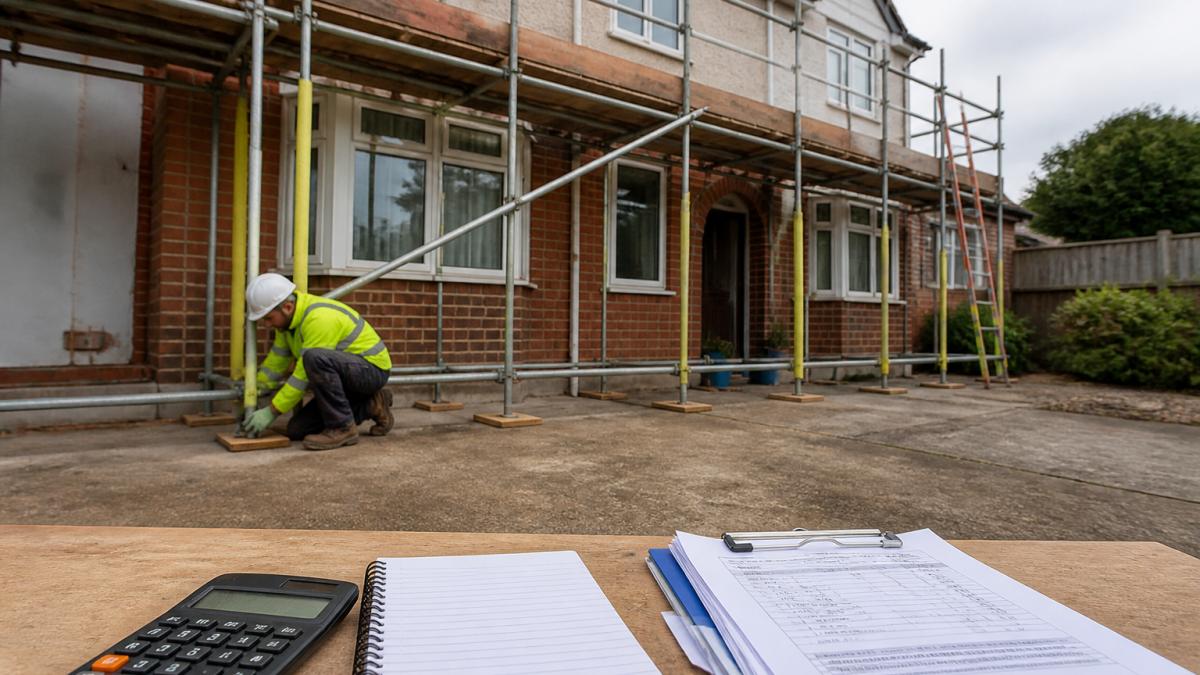
What most guides miss is that the weekly rate is not the price of the scaffold. It is the price of the scaffold staying where it is. Every extra week you keep it up is a week it cannot earn elsewhere, and that is what you are paying for.
Scaffolding Hire Duration for Renovations: Why Ten Weeks Is the Benchmark
Scaffolding hire duration for renovations is the total time the structure stands on your property, and ten weeks is the benchmark most domestic packages are built around. That window covers a typical roof replacement, a render or repaint job, or the external phase of a single-storey extension without the quote being rewritten mid-project.
The reason ten weeks matters is that renovation timelines slip. Trades get delayed, materials arrive late, and weather stops work. When hire is included for that full period, a two-week slip does not trigger a new charge.
If your project is genuinely short, a two-week repaint for example, ask whether the package can be adjusted. If it is longer, ask what the weekly rate is after the included period ends. Both answers belong on the quote.
Scaffolding Pavement Licence: The Cost Most Homeowners Forget
A scaffolding pavement licence is the permission your local council grants before a scaffold can stand on a public footpath or highway. It is the line item homeowners most often overlook, and it is the one most likely to delay a project if it is not handled early.
The licence is not optional (Scaffolding rules). If any part of the structure, including base plates or a fan, sits on public land, the council must approve it. Applications are made to the local highway authority, and the GOV.UK guidance on pavement licences sets out how councils handle these permissions. Fees, processing times and conditions vary by authority, so the amount you pay depends on where you live and how much public space the scaffold occupies.
Here is where the paperwork usually goes wrong. Homeowners assume the scaffolding company sorts the licence, then discover nobody applied. We handle highway licensing as part of the package.
Scaffolding Quote Checklist: Nine Things to Confirm Before You Sign
A scaffolding quote checklist is the set of questions you run through before signing, and it exists because most disputes come from what the quote did not say. Work through these before you commit:
- Is the hire period stated in weeks, and what is the weekly rate after it ends?
- Does the price include erection and dismantling, or are they billed separately?
- Who applies for the pavement licence, and who pays the council fee?
- Is the structure designed and inspected by a competent person, with records?
- Are brick guards, netting or fans included, or charged as extras?
- Is the quote written and dated, or just a verbal estimate?
- What happens if the project overruns by two weeks?
- Are the scaffolders trained and insured for domestic work?
- Is there a named contact if something needs adjusting mid-job?
Two of these carry more weight than the rest. The hire period and the licence. Get those wrong and the cost moves after you have signed.
Example Scenarios: Three Residential Jobs and What Drives Their Price
Three typical jobs show how the same structure can be priced differently depending on duration, access and licensing.
| Job | Structure | Duration | Main Cost Drivers |
|---|---|---|---|
| Roof replacement, terraced house | Front elevation, two lifts | 8 weeks | Tight access, pavement licence required |
| Full repaint, detached house | Wrap-around, three lifts | 3 weeks | Large area, easy driveway access |
| Single-storey extension | Side and rear, two lifts | 10 weeks | Long duration, partial highway occupation |
The terraced roof job costs more per week than the repaint despite covering less area, because the pavement licence and restricted access both add labour and administration. The extension runs longest, so the included hire period matters most there.
This is the pattern to remember: price follows access and duration, not just size.
Conclusion
The hardest part of budgeting for scaffolding is that the final figure depends on factors you cannot fully control, from council processing times to how long your roof actually takes. Ironclad Scaffolding includes ten weeks of hire in every package, provides written quotes within 24 hours, and handles the highway licence on your behalf. Our 3D scaffold viewer also lets you see exactly how the structure will sit against your property before anything is ordered. Get started with Ironclad Scaffolding and price your project with the full picture in front of you.
Frequently Asked Questions
How much does residential scaffolding hire cost?
Residential scaffolding hire cost depends on four things: the size of the elevation, how long you need the structure, whether a pavement licence is required, and how straightforward access is. Two similar-looking houses can differ because one needs a licence and a traffic cone permit while the other sits behind a driveway. Because pricing is project-specific, ask for a written quote that lists hire, erection, dismantling, licence fees and any weekly rate after the included period.
How long is scaffolding hire included in the price?
Included hire periods vary by provider. Some quote a fixed four-week window and then charge weekly; others bundle a longer term into the headline figure. Ironclad Scaffolding includes ten weeks of hire in every package, which suits roof replacements, render work and extensions where weather or trade sequencing causes delays. Always confirm the included period in writing and ask what the weekly rate becomes once it ends.
Do I need a licence to put scaffolding on a public pavement or road?
Yes, if any part of the structure sits on public highway, including a pavement. You need a scaffolding pavement licence from the local highway authority, which in most areas means the county or unitary council. Applications take time to process and the licence carries its own fee, plus conditions on lighting, signage and protective fans. Some providers handle the application for you, which removes a common source of delay.
What can make scaffolding hire cost more?
Costs rise when the scaffold needs a pavement licence, when the ground is uneven or sloping and needs extra base work, when the property has conservatories, porches or dormers that block a straight run, and when the structure must be built over a public footpath with protection. Longer hire periods beyond the included term also add cost. Restricted access for the delivery lorry, such as narrow lanes, can add time and labour to the erection.
Is scaffolding charged by the week or as a fixed package?
Both models exist. A fixed package bundles erection, hire for a set period, and dismantling into one figure, which makes budgeting simpler. A weekly model charges for the structure plus a weekly hire rate that starts immediately. The weekly model can work out cheaper on very short jobs of two to three weeks, while a package usually wins on anything longer because the included hire period absorbs delays.
Can scaffolding hire be extended if renovation work runs over?
Extensions are usually possible, but the rate changes. Once the included hire period ends, most providers charge a weekly rate until dismantling. Confirm that rate before work starts so an overrun does not become a surprise. If the scaffold sits on public highway, the pavement licence may also need extending, which means a further application and fee. Build a two to three week buffer into your schedule.
How can I compare scaffolding quotes fairly?
Put every quote through the same checklist. Confirm what is included: erection, dismantling, hire period, licence application and fee, weekly rate after the included term, and whether the price covers a site survey. A cheaper headline figure often excludes the licence or assumes a shorter hire window. Ask for the total cost assuming your job runs two weeks longer than planned, then compare that number rather than the initial quote.