 how-to
Scaffolding Permit Process for Homeowners: 2026 Guide
Table of Contents
- Do You Need a Scaffolding Permit? Public Highway vs Private Property
- Who Applies for a Scaffolding Licence: Homeowner or Contractor?
- The Scaffolding Licence Application: Documents and Site Plans You Need
- Scaffolding Licence Processing Time and Advance Notice
- Scaffolding Permit Cost: What Councils Charge and Why
- Scaffolding on a Public Pavement: Safety, Access and Conditions
- What Happens If Work Is Delayed, Extended or Cancelled
- Conclusion
- Frequently Asked Questions
Last Updated: October 17, 2026
Do You Need a Scaffolding Permit? Public Highway vs Private Property
A scaffolding permit is official permission from your local council to place scaffolding on public land, such as a pavement or road.
Most homeowners in Kent assume the scaffolder sorts everything. Often they do, but you own the risk if the paperwork is wrong.
The rule comes down to one question: where do the feet of the scaffold stand?
- On a public pavement or road: you need a licence from the local highway authority.
- Entirely inside your boundary: private land, so no highway licence is needed.
- Straddling both: treat it as public, because any part on the highway counts.
That distinction drives the cost, the wait, and who fills in the form.
When Scaffolding on a Public Pavement Requires a Licence
Any scaffold on a public pavement, road, or verge needs a licence under the Highways Act 1980, which lets councils control anything placed on the highway.
Most residential roof repairs and exterior painting jobs need some pavement space, because the scaffold must stand back from the wall to be stable.
Your council will also want to see how pedestrians get past: a covered walkway, a hoarding, or a signed diversion, set out in the licence conditions.
Scaffolding on Private Property: When You Can Skip the Permit
If every foot of the scaffold sits inside your boundary, you can skip the highway licence. A driveway, front garden, or side return all count as private property.
But check the boundary carefully. A dropped kerb, a grass verge, or a shared access path may still belong to the council. Scaffolders call this the "highway line", and it catches people out.
Who Applies for a Scaffolding Licence: Homeowner or Contractor?
The appointed contractor normally applies for the scaffolding licence, and the homeowner usually pays. That split is common but not fixed.
Our advice: let the scaffolder apply.
You still have a role. Confirm in writing who is applying, who is paying, and what happens if the council rejects it.
A common mistake is assuming the builder is handling it when they are not.
Who Is Liable When Something Goes Wrong
The licence is usually granted to the applicant, who carries the conditions. In practice:
- If the contractor applies: the contractor is the licence holder and is answerable to the council for breaches of condition, such as scaffolding left up past the expiry date or a walkway removed too early. The council will pursue the licence holder first.
- If the homeowner applies: the homeowner becomes the licence holder and takes on that accountability, even though the contractor erected the structure. That is why most practitioners advise against a homeowner applying in their own name unless the contractor insists.
- Damage to the highway: if the scaffold damages a pavement, kerb, or street furniture, the council will look to the licence holder and their public liability insurer. Check that the contractor's policy covers highway damage, not just injury to workers.
The Written Agreement You Should Have Before Work Starts
A quote is not enough. Before the scaffold goes up, confirm the following in writing, even if only by email:
- Who is named as the licence applicant and therefore the licence holder.
- Who pays the application fee, the licence fee, and any extension charges.
- Who is responsible for renewing the licence if the work overruns, and by what date.
What Happens If the Council Rejects the Application
Rejection is usually about missing information, not refusal in principle. The council may ask for a revised site plan, a narrower scaffold, or a different pedestrian route. Responsibility sits with the applicant: if the contractor applied, they should resubmit at their cost; if you applied, the resubmission and any further fee are yours. Agree this in advance.
Insurance and Damage: The Homeowner's Position
Your own home insurance rarely covers scaffolding on the public highway; the contractor's public liability policy is the relevant cover. Ask for the policy schedule, check the limit, and confirm it is current for the works. Reluctance is a warning sign.
The Scaffolding Licence Application: Documents and Site Plans You Need
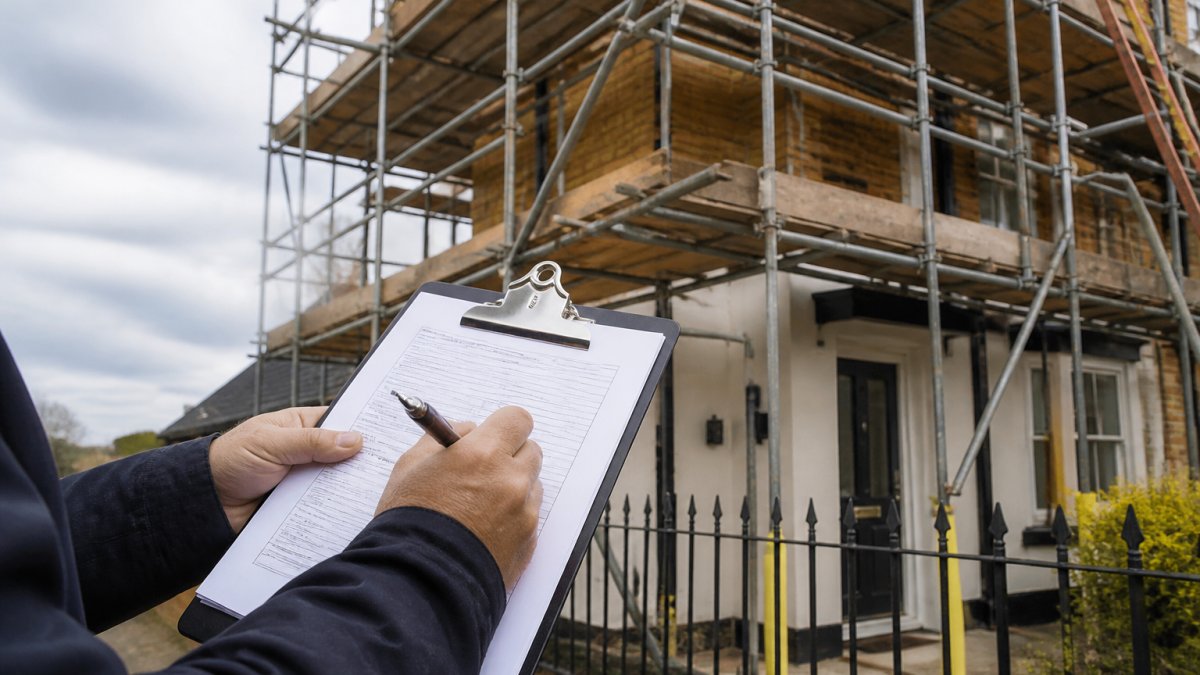
A scaffolding licence application needs four things: a completed form, a site plan, the licence fee, and details of the scaffold. Some councils also ask for public liability insurance and a method statement.
Here is the checklist we would use:
- Completed application form from the council's highways team
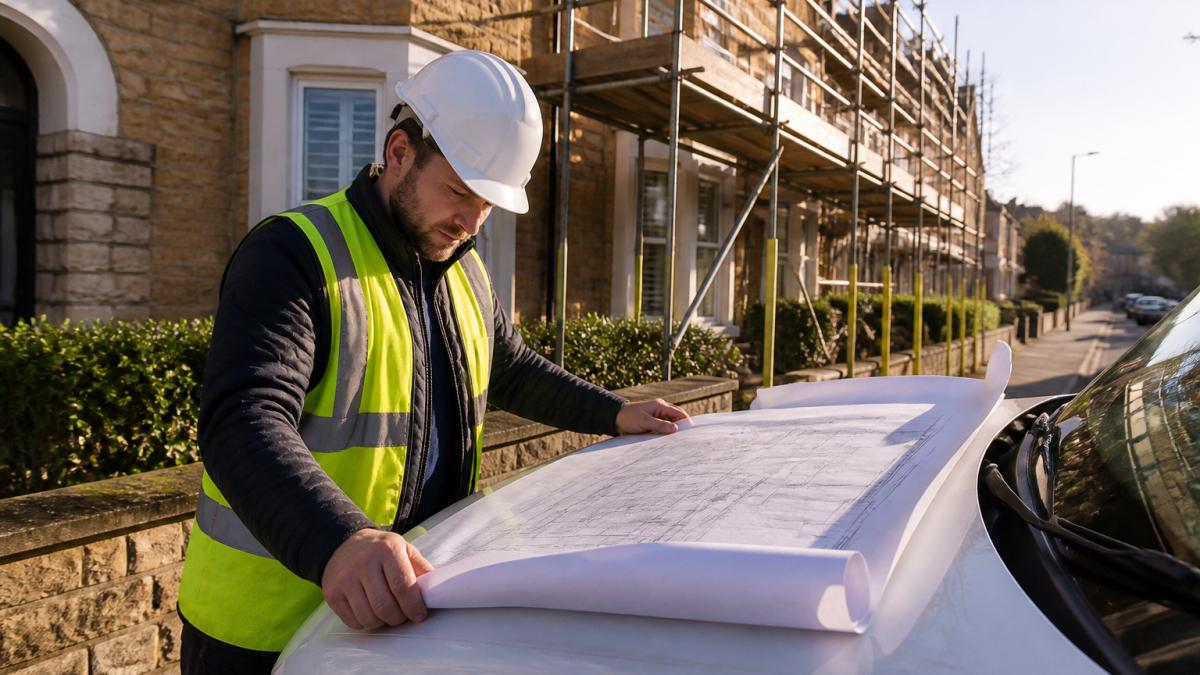
- Site plan showing the property, the pavement, and the scaffold footprint
- Scaffold dimensions in metres, including height and length
The site plan is where most applications stall. It must show the site location, the pavement width, and how pedestrians will pass; a rough sketch will usually be sent back.
What a Compliant Site Plan Actually Shows
Most councils publish no template, so homeowners guess. A plan approved on first submission usually contains the following, drawn to a consistent scale (1:100 or 1:200 is common):
- The property boundary, marked as a solid line, with the house footprint labelled.
- The highway line, marked separately, so the case officer can see exactly which scaffold feet sit on council land.
- The scaffold footprint, shown as a hatched rectangle with its length and width in metres, and the distance from the wall to the outer edge.
Councils commonly reject plans that show the scaffold but not the pavement width, since the case officer cannot judge whether pedestrians can pass. A missing scale bar is another frequent rejection.
A Worked Example of the Numbers Councils Ask For
Suppose a mid-terrace house has a 6 m frontage and the scaffold is 8 m high. The scaffold stands 0.9 m out from the wall, and the pavement is 1.8 m wide. The plan should state:
- Scaffold length along the frontage: 6 m
- Scaffold height: 8 m
- Stand-off from wall: 0.9 m
Those five figures are what a highways officer checks first. Supplying them upfront avoids requests for further information, the most common cause of delay.
Documents That Catch Homeowners Out
- Public liability insurance: the certificate must name the contractor and show a limit that meets the council's minimum, which varies. Ask for the certificate before the application goes in, not after.
- Method statement: a short document setting out how the scaffold will be erected, how pedestrians will be protected, and the inspection regime. Some councils accept a one-page summary; others want the full construction phase plan.
- Traffic management plan: only needed where the scaffold affects the carriageway or a bus route, but when it is needed, it often requires a separate temporary traffic regulation order, which adds weeks.
Scaffolding Licence Processing Time and Advance Notice
Processing time varies by council, so apply early. Many authorities ask for at least five to ten working days' notice; busy periods and complex sites take longer.
Plan for two weeks as a working assumption, then add a buffer. Narrow roads, bus routes, and schools attract more scrutiny.
Some councils offer an emergency application for urgent work such as storm damage.
Scaffolding Permit Cost: What Councils Charge and Why
Scaffolding permit cost depends on your council, the scaffold size, and how long it stays up. There is no single national fee; each highway authority sets its own charges.
Charges usually combine three elements:
- An application fee: often non-refundable, paid when you submit.
- A licence fee based on scaffold dimensions: often calculated per square metre or per metre of frontage.
- A charge for the permit period: many councils price the first 28-day period, then charge for extensions.
Some councils also take a deposit, refunded when the scaffold comes down and the pavement is left clean.
Because fees vary so widely, we will not quote a figure here. Check your own council's highways page for current charges, or ask your scaffolder, who will know the local rate.
Scaffolding on a Public Pavement: Safety, Access and Conditions
Safety and public access are what councils care about most. A licence is conditional, and breaching the conditions can mean it is withdrawn.
Expect conditions covering:
- Pedestrian access: a covered walkway or hoarding so people can pass safely.
- Highway safety: warning lights, cones, and signage, especially at night.
- Scaffold standards: the structure must meet the relevant safety requirements and be inspected.
The Health and Safety Executive treats scaffolding as work at height, and the structure should be inspected before first use and at regular intervals. Ask your contractor for their inspection records.
What Happens If Work Is Delayed, Extended or Cancelled
Delays are the most common problem, and they cost money. If work overruns the permit period, renew before the licence expires, do not wait until the last day.
If work is cancelled after the licence is granted, the application fee is usually lost, hence "non-refundable".
If the scaffold comes down early, tell the council. Some authorities refund part of the charge or release a deposit once they have inspected the pavement.
Our own packages include ten weeks of hire, which covers most domestic jobs. If a roof repair runs longer, extra weeks are charged, so ask for that rate up front rather than discovering it later.
Conclusion
The scaffolding permit process for homeowners comes down to three things: knowing where your scaffold stands, agreeing who applies, and applying early. Get those right and the paperwork is a formality.
At Ironclad Scaffolding, we handle the highway licence for you, include ten weeks of hire in every package, and send written quotes within 24 hours. Our 3D scaffold viewer lets you see exactly how the structure will sit against your house before anything is ordered.
Frequently Asked Questions
Who applies for a scaffolding licence: the homeowner or the scaffolding company?
In most cases the scaffolding contractor applies on the homeowner's behalf, because they hold the insurance certificates, method statements and site plans the council requires. The licence is usually granted to the contractor, but the homeowner remains responsible for ensuring one is in place before work starts. If you hire a company that handles highway licensing as part of the package, you should not need to contact the council yourself. Always confirm in writing who is submitting the application.
How long does it take to get a scaffolding licence?
Processing times vary by local authority. Many councils ask for at least 10 working days' notice, while others request 15 or more for standard applications. Emergency applications can sometimes be turned around faster, but they often attract a higher fee. Build this notice period into your project schedule rather than assuming approval is instant. If your scaffolding licence processing time is tight, speak to your contractor early so the application is submitted as soon as the site plan is ready.
How much does a scaffolding licence cost?
Fees are set individually by each local authority, so there is no single national figure. Charges typically combine an application fee and a permit fee, and some councils add a charge for extensions or inspections. Most fees are non-refundable even if the application is rejected. Your scaffolding permit cost will depend on the length of the permit period and the amount of public highway occupied. Ask your contractor for a written breakdown before work is booked.
What happens if you put scaffolding up without a permit?
Erecting scaffolding on a public highway without a licence is a breach of the Highways Act and can lead to enforcement action from the local council. They may require the structure to be removed immediately, and you could face fines or costs. It also leaves you exposed if a member of the public is injured, as insurance may be invalid without a valid licence in place. Always confirm the licence has been granted before the scaffolders arrive on site.