 how-to
Scaffolding Hire Duration for Roof Repairs: How Long?
Last Updated: October 23, 2026
Quick Summary
Most domestic roof repairs need scaffolding for two to four weeks, and the scaffolding hire duration for roof repairs is driven by the work itself, not by a fixed industry rule. At Ironclad Scaffolding, we include ten weeks of hire in every package because that covers the realistic span of a re-roof, chimney repoint or guttering replacement without panic.
- A chimney repoint or guttering job usually keeps scaffolding up for one to three weeks.
- A full re-roof commonly runs four to eight weeks of hire.
- Erection and dismantling each take roughly half a day to a day and count towards hire.
- Many roofing contractors add 20-30% to expected working days to account for weather.
- Extension rates after a fixed term are often far higher than the original weekly rate.
Table of Contents
- Scaffolding Hire Duration for Roof Repairs: The Short Answer
- How Long Does Scaffolding Stay Up for a Typical Roof Repair?
- What Drives Scaffolding Hire Duration: The Factors That Extend It
- Scaffolding Hire Cost Per Week and What the Quote Covers
- Scaffolding Hire Extension Charges: What Happens After the Fixed Term
- What to Check in a Scaffolding Hire Agreement Before You Sign
- Permits, Insurance and Liability: The Parts Most Homeowners Miss
- How to Avoid Hidden Charges and Negotiate a Fair Hire Period
- Frequently Asked Questions
Scaffolding Hire Duration for Roof Repairs: The Short Answer
Most domestic roof repairs need scaffolding for two to four weeks, and the scaffolding hire duration for roof repairs is driven by the work itself, not by a fixed industry rule. At Ironclad Scaffolding, we include ten weeks of hire in every package because that covers the realistic span of a re-roof, chimney repoint or guttering replacement without panic. Below, we explain what actually extends a hire, what the quote should cover, and how to avoid paying for weeks you never use.
The short answer matters because most homeowners budget for the repair and forget the hire clock. Scaffolding hire duration is the total time the structure stands on your property, from erection to dismantling. That clock includes the days nobody is on the roof.
How Long Does Scaffolding Stay Up for a Typical Roof Repair?
A straightforward repair such as a chimney repoint or a section of guttering usually keeps scaffolding up for one to three weeks. A full re-roof or a domestic re-roof with felt and batten replacement commonly runs four to eight weeks.
Here is the practical split:
- Chimney repointing: 1-2 weeks, plus erection and dismantling days
- Guttering or fascia replacement: 1-2 weeks
- Localised roof repair: 1-3 weeks
- Full roof replacement: 4-8 weeks
Erection and dismantling each take roughly half a day to a day on a typical semi. Those days count towards the hire period. Ask any provider to state them in writing.
What Drives Scaffolding Hire Duration: The Factors That Extend It
The biggest driver of scaffolding hire duration is not the roofers' speed. It is the things that stop them working: weather, access, ground conditions and the discovery of extra faults once the tiles come off.
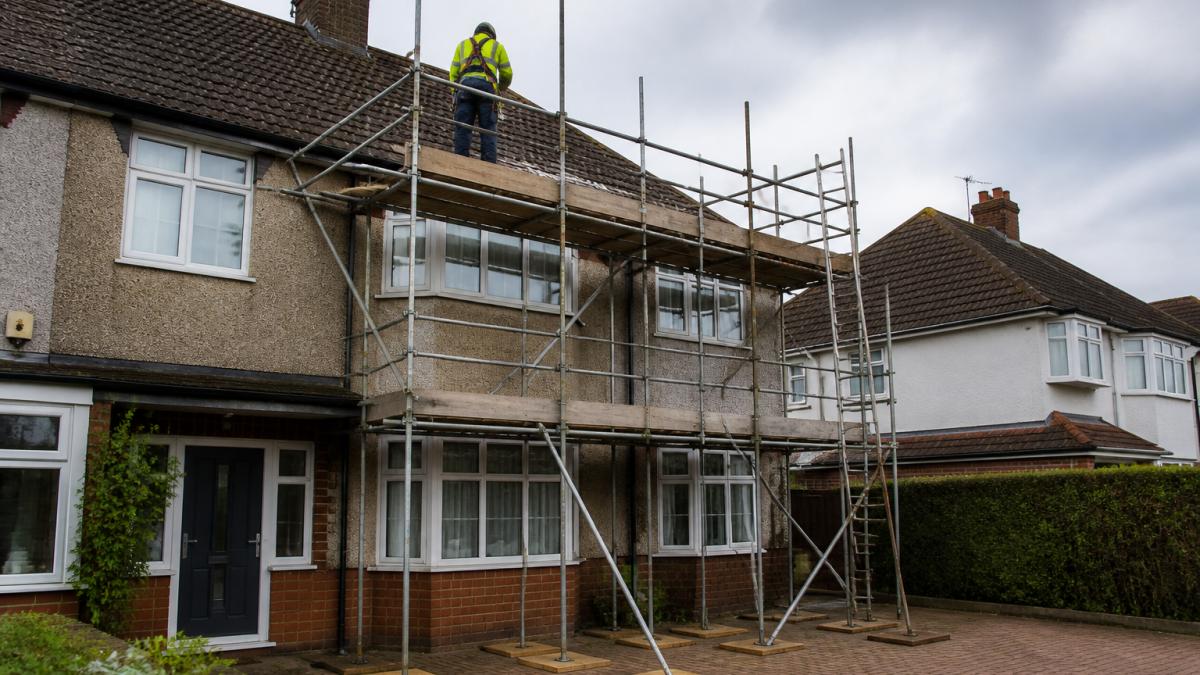
Weather Delays and Standby Charges
Wind and rain stop roof work, and the scaffold cannot come down safely in high winds either.
The question most homeowners never ask is whether the provider charges for 'standby' time. Some do, some don't, and the difference can be hundreds of pounds over a wet month.
A practical rule of thumb used by many roofing contractors is to add 20-30% to the expected on-site working days to account for weather.
Access, Ground Conditions and Site Constraints
Access matters just as much as weather. Narrow driveways, parked cars, conservatories and low cables all slow erection and can force a redesign.
Ground conditions are the quiet cost driver. Scaffold legs sit on base plates and sole boards, and those need firm, level ground.
If the scaffold needs to span a public pavement, the structure may also need a protective fan or gantry, which takes longer to build and longer to dismantle.
Chimney Repairs, Re-Roofs and Guttering
Different jobs need different scaffold structures. A chimney stack needs a working platform at height. A full re-roof needs a full run with loading bays for tiles. Guttering work often needs only a narrow tower.
Each structure has its own erection time, and that time sits inside your hire period. Match the scaffold to the job and you avoid paying for capacity you do not need.
Scaffolding Hire Cost Per Week and What the Quote Covers
Scaffolding hire cost per week depends on the size of the structure, the access, the ground conditions and the hire term, so we quote each property individually rather than publish a rate. Ask for a written quote within 24 hours and check exactly what it covers.
A proper quote should itemise:
- Erection and dismantling labour
- Weekly rental rate for the scaffold structure
- Base plates, sole boards and ties
- Highway licence fees, where a pavement licence is needed
Scaffolding Hire Extension Charges: What Happens After the Fixed Term
Scaffolding hire extension charges are the weekly fees you pay once the agreed hire period runs out. They are usually higher than the original weekly rental rate, and they are where most disputes start.
Ask three questions before signing:
- What is the extension rate per week?
- Is there a minimum extension period, such as a full week or a month?
- Who triggers the extension, you or the contractor?
If your roofer finds dry rot or a cracked purlin, the job stretches and the hire stretches with it. A ten-week inclusive period gives you room for that without a phone call and a surcharge.
What to Check in a Scaffolding Hire Agreement Before You Sign
The scaffolding hire agreement is the document that decides what you pay if the job overruns. Read it before the scaffold goes up, not after.
Check these points:
- Hire start and end dates, stated as calendar dates
- Minimum hire period, often quoted in weeks
- Extension rate and how it is triggered
- Who is responsible for site security overnight
Permits, Insurance and Liability: The Parts Most Homeowners Miss
If the scaffold sits on or over a public pavement, you usually need a pavement licence (sometimes called a scaffold licence or highway licence) from the local highway authority (Scaffolding and hoarding licence (England and Wales)). The UK government guidance on scaffolding and pavement licences sets out how councils manage these.
The mechanism matters more than the label. Most councils require a site plan, a copy of the scaffold design, evidence of public liability insurance, and a traffic management plan if the structure narrows the footway.
A licence is not always required. If the scaffold sits entirely within your own boundary, a back garden, a private drive, you generally do not need one.
Insurance: Who Covers What
Insurance is the second gap. Ask for a copy of the provider's public liability insurance before work starts. Check the cover level and the expiry date.
There are two separate risks to check. The first is injury or damage caused by the scaffold to a third party, a tile falling on a passer-by, or a pole striking a parked car. That should sit with the scaffold company's public liability policy, and you should see the certificate.
Liability for the Standing Structure
Liability for the scaffold itself normally sits with the hire company, but only if the agreement says so. Working at height rules under HSE guidance on working at height put duties on everyone involved, including the homeowner who commissions the work.
A common pattern is for responsibility to split three ways: the scaffold company owns the structure and its inspection regime; the roofing contractor controls the work on it; and the homeowner controls access to the property. If something goes wrong, the agreement should make clear which party is responsible for which. If it doesn't, ask for it to be clarified before the first pole goes up.
How to Avoid Hidden Charges and Negotiate a Fair Hire Period
Negotiation starts with knowing your project timeline. Ask your roofer for a realistic start and finish date, add a weather buffer, and compare that to the hire period on the quote. If the gap is thin, negotiate now.
Try these moves:
- Ask for an inclusive hire period rather than a weekly rate
- Request the extension rate in writing before signing
- Confirm the erection and dismantling days are included
- Ask whether the highway licence is handled for you
- Get the quote in writing, not over the phone
At Ironclad Scaffolding, we handle the highway licence and include ten weeks of hire as standard, so a weather delay or a hidden fault does not turn into a surprise invoice. Our instant quotes and 3D scaffold viewer let you see the structure on your property before you commit.
Frequently Asked Questions
How long is scaffolding usually needed for roof repairs?
Most domestic roof repairs keep scaffolding in place for two to six weeks. A small chimney repoint or a section of guttering might need only a week or two, while a full re-roof or a repair involving new felt and battens commonly runs four to eight weeks. Hire agreements normally set a minimum hire period, often four weeks, so short jobs still pay for that floor. Ironclad Scaffolding includes ten weeks of hire in every package, which covers most domestic roof repair timelines without an extension charge.
What can delay roof repairs and extend scaffolding hire?
Weather is the biggest cause. Wind above safe working limits stops roofers going up, and rain prevents felt, battens and render from being fitted. Other delays include discovering rotten timbers once tiles come off, waiting on a council pavement licence, restricted site access that slows erection, and ground conditions that need sole boards or base plates repositioned. Each week of delay can trigger scaffolding hire extension charges, so build a buffer into your budget and confirm the weekly rate in writing before work starts.
How is extra scaffolding hire charged after the included period?
Extra hire is normally charged as a weekly rental rate applied to each week the scaffold structure stays up beyond the fixed-term contract. Some agreements charge pro rata for part weeks, others round up to a full week. The rate should be stated in the hire agreement before you sign, alongside any re-inspection fee if the scaffold is up longer than a set period. Ask for the extension charge in writing and check whether it includes the weekly rental rate only or also covers additional safety compliance inspections.
Do you need a pavement licence for scaffolding on a roof repair?
If any part of the scaffold sits on the public highway, pavement or footpath, you need a pavement licence from the local highway authority before erection. This applies to most terraced and semi-detached homes where the front elevation is close to the road. The licence usually runs for a set period and must be renewed if the hire duration overruns. Ironclad Scaffolding handles the highway licence as part of its domestic service, so the administrative side is managed for you, but the licence conditions still bind the property owner.
Scaffolding hire duration is the number most homeowners forget to check, and it is the one that decides the final bill. Get the hire period, extension rate and licence terms in writing before you sign. Ironclad Scaffolding offers instant quotes, a 3D scaffold viewer, written quotes within 24 hours, ten weeks of hire included and highway licence handling as standard. Get started with Ironclad Scaffolding and plan your roof repair with the full hire period agreed up front.