 blog
What Is the Best Domestic Scaffolding for Roof Work?
Last Updated: October 25, 2026
Quick Summary
The best domestic scaffolding for roof work is a compliant tower or independent tied scaffold with a protected working platform set just below the eaves, guardrails and toe boards on every platform, and a design that accounts for roof pitch. Ties fixed into the masonry keep it stable, and most roof projects need it for four to eight weeks.
- Ties should be checked at handover and again at intervals during the hire.
- The hire clock usually starts at erection and stops at dismantle, not at the first day of work.
- Two houses on the same street can attract very different quotes because of access and licensing.
- A quote that omits the highway licence is incomplete, not cheaper, because the charge appears later.
- Ask for evidence of insurance and training before anyone erects anything on your property.
Table of Contents
- What Makes Domestic Scaffolding Right for Roof Work?
- Scaffolding Tied to a House: How It Stays Stable
- Scaffolding Hire Duration for Renovations: How Long You Actually Need It?
- What Drives Roof Scaffolding Hire Cost?
- The Scaffold Inspection Checklist Every Homeowner Should Know
- Common Mistakes When Choosing Domestic Scaffolding
- Book a Domestic Scaffolding Quote and See It on Your House First
- Frequently Asked Questions
What Makes Domestic Scaffolding Right for Roof Work?
Roof work is the single most common reason homeowners need domestic scaffolding, and the right system is the one that gets a crew safely to the eaves and ridge without overloading the structure or blocking the pavement. For most two-storey houses, that means a compliant tower or independent tied scaffold with a protected working platform at roof level.
Domestic scaffolding is temporary access equipment erected at a residential property to give trades safe, stable access to the exterior of a house. It differs from commercial scaffolding in scale, loading and how it is tied back to the building. While these structures provide a secure platform for heavy materials, alternative methods such as rope access safety offer a versatile approach for lighter tasks that require minimal footprint.
Three things separate a suitable roof scaffold from an unsuitable one:
- Working platform height set just below the eaves, so workers can step onto the roof rather than climb to it
- Guardrails and toe boards on every platform, plus a ladder access point that is itself protected
- A design that accounts for roof pitch, because a steep roof needs different edge protection from a flat one
We would not put a homeowner on a scaffold without a design that names the roof type and the load it will carry. A step-by-step guide to how scaffolding is set up and used for roof repairs covers the sequence from ground survey to handover.
Scaffolding Tied to a House: How It Stays Stable
Stability comes down to one principle: the scaffold must be restrained against the building at regular intervals. Scaffolding tied to a house uses physical ties fixed into the masonry, which stop the structure pulling away from the wall or toppling in wind.
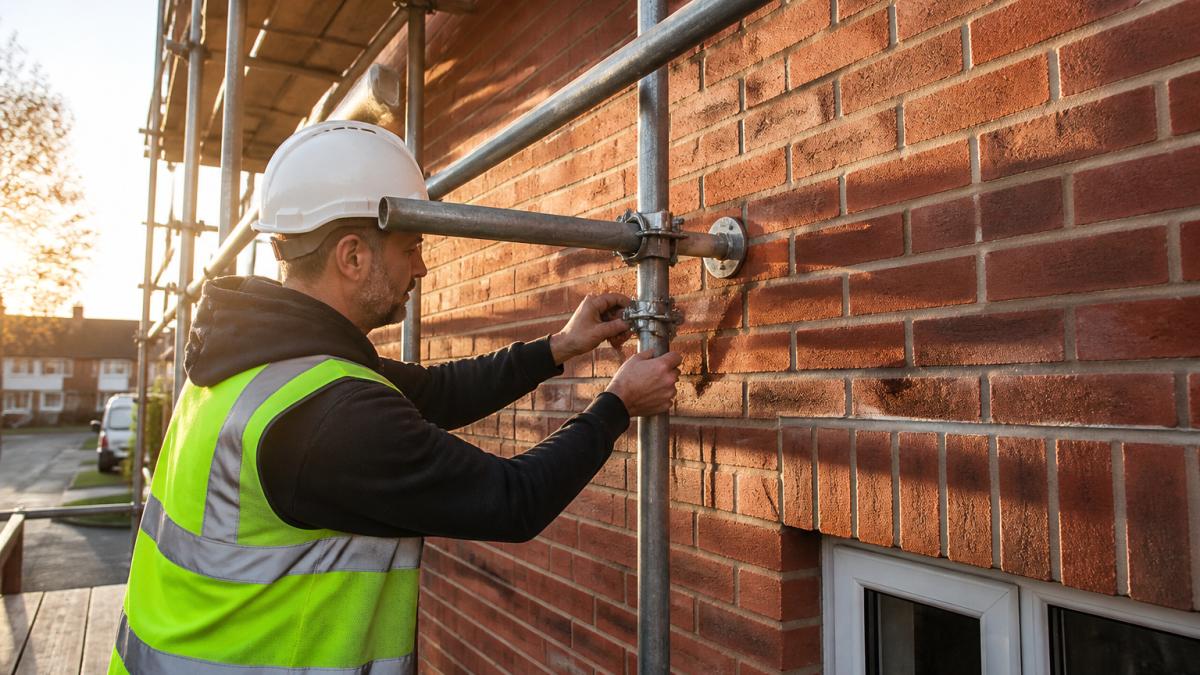
Ties are not optional extras. A scaffold that relies on its own weight alone is only acceptable at low heights and in sheltered positions, and even then only with the right design. On an exposed site, ties are what keep the whole structure where it should be.
What most guides miss is the tie test. Ties should be checked at handover and again at intervals during the hire, because a tie that has worked loose in the brick is invisible from the ground. Ask for the tie pattern in writing before erection starts.
Scaffolding Hire Duration for Renovations: How Long You Actually Need It?
Most domestic roof projects need scaffolding for between four and eight weeks, though the honest answer depends on the trade sequence rather than the roof itself. A straightforward re-roof often finishes inside a month; a repair that waits on materials or weather can run much longer.
The hire clock usually starts at erection and stops at dismantle, not at the first day of work. That gap matters. If your roofer is booked for three weeks' time, you may be paying for an empty scaffold.
A common mistake is ordering scaffolding to arrive on day one of the project. In practice, you want it up the day before the trades start and down the day after they finish. Every week in between is a week on the invoice.
We include ten weeks of hire in every package for exactly this reason. Roof work rarely runs to a tidy schedule, and the last thing a homeowner needs is a weekly charge ticking while they wait for a delivery. For a fuller breakdown of typical timelines, see how long scaffolding hire for roof repairs usually lasts.
What Drives Roof Scaffolding Hire Cost?
Roof scaffolding hire cost is set by access, height, duration and paperwork, not by the roof covering. Two houses on the same street can attract very different quotes because one has a driveway and the other needs a highway licence.
Four factors do most of the work:
| Cost driver | What pushes it up | What keeps it down |
|---|---|---|
| Height and shape | Three storeys, complex rooflines, chimneys | Simple two-storey front elevation |
| Access | No rear access, sloping ground, obstructions | Clear driveway or garden access |
| Duration | Long hire periods, repeated visits | Tight trade sequence |
| Licensing | Scaffold over a pavement or road | Scaffold wholly on private land |
Pricing depends on quantity, dates and access, so we quote each property individually rather than publishing a rate card. A detailed cost breakdown for residential scaffolding hire explains how each line is built up, and our 2026 price guide for domestic scaffolding walks through the factors behind a quote.
Watch out: a quote that omits the highway licence is not a cheaper quote, it is an incomplete one. The charge simply appears later.
The Scaffold Inspection Checklist Every Homeowner Should Know
A scaffold inspection checklist gives you a way to spot problems between professional inspections rather than trusting that everything is fine. You are not the competent person, but you can still flag what looks wrong.
- Ties present and tight against the wall at the agreed spacing
- Guardrails and toe boards fitted on every platform
- Base plates sitting flat on firm ground or timbers
- Ladder secured and extending above the platform
- No missing boards or gaps in the decking
- Scaffold tags or handover records available on request
- Bricks or fixings visibly disturbed around any tie
The Health and Safety Executive guidance on scaffolding sets out who may inspect and how often, and it is worth reading before your scaffold goes up so you know what to ask for. If something on the list looks wrong, stop and call the provider. Do not climb up to check it yourself.
Common Mistakes When Choosing Domestic Scaffolding
The biggest mistake is choosing on price alone and discovering the gaps later. A cheap quote that excludes licensing, or assumes a short hire, rarely stays cheap.
Here is what we see most often:
- Assuming the quote is fixed. Ask what happens if the job overruns and how the extra weeks are charged.
- Skipping the design conversation. The provider should ask about roof pitch, chimney position and access before quoting.
- Ignoring the pavement. If the scaffold crosses public highway, the licence is a real task with a real lead time.
- Not checking insurance and training. Ask for evidence before anyone erects anything on your property.
One insider point: the provider who asks the most questions at quote stage is usually the one who has done the most roof jobs. A five-minute quote with no survey is a red flag, not a convenience.
Book a Domestic Scaffolding Quote and See It on Your House First
The best way to judge a scaffold is to see it before it exists. That is why we built a 3D scaffold viewer: you send us your property details, and we show the scaffold positioned against your actual house so you can check heights, access and how it sits against the roofline before you commit.
HSE's guidance on construction site safety is clear that planning access properly at the start prevents most incidents later. Seeing the design first is part of that planning.
Our written quotes arrive within 24 hours, we handle the highway licence for you, and ten weeks of hire is included as standard. If you want to understand the visual planning side in more depth, read about 3D scaffold planning for home projects.
Frequently Asked Questions
How is scaffolding secured to a house?
Domestic scaffolding is secured to a house using tie assemblies fixed into the brickwork or masonry at regular intervals, usually every lift height and bay width. The ties stop the structure pulling away from the wall in wind. A competent erector checks the type of tie against the wall construction, because soft stone or rendered blockwork needs different fixings from solid brick. Never let anyone remove a tie to make access easier without the erector's approval.
How long can scaffolding be left up for roof work?
There is no fixed legal limit, but the scaffolding hire duration for renovations is usually driven by the roof programme. Most domestic roof jobs run four to eight weeks, and packages that include ten weeks of hire cover the typical overrun. After that, weekly charges apply. Keep the structure up only as long as work is progressing, and book a handover inspection before it comes down.
Do I need a licence to put scaffolding on a public pavement?
Yes, if any part of the scaffold sits on the highway, including the pavement, you need a highway licence from the local council. The application, fee and conditions are set by that authority, and approval can take time. A provider that handles the licence for you removes the risk of an unlicensed structure and the enforcement action that follows. Ask who is named on the application before you sign.
What safety checks should be carried out on domestic scaffolding?
Use a scaffold inspection checklist: check ties are in place and tight, base plates sit on firm ground, boards are complete and secured, guardrails and toe boards are fitted, access ladders are tied and internal, and nothing is propped against the structure. Inspections should be recorded before first use, after alteration, and at intervals not exceeding seven days. Report anything loose or missing to the erector the same day.
Roof work does not wait, and neither should your quote. At Ironclad Scaffolding we give you an instant quote, a 3D view of the scaffold on your own house, and a written quote within 24 hours, with the highway licence handled and ten weeks of hire included. Get started with Ironclad Scaffolding and see exactly what your roof project needs before you book.